Coding Standards
Go
Formatting
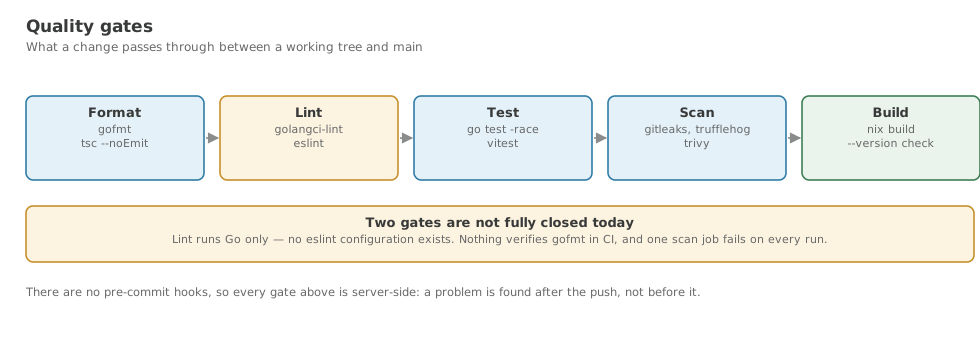
All Go code is formatted with gofmt -s, and CI rejects anything that is not.
Both are the same script, scripts/gofmt-check.sh, which is also what the lint-go job runs as its first step. There is deliberately only one implementation: if the gate and the formatter were two commands they would eventually disagree about -s, about which files are vendored, or about both, and the disagreement would only ever be discovered by a red build.
The check runs in about a second — it needs no cgo, no webkit and no linter binary — so it is the first thing CI asks and the cheapest thing to run before a push. The gofmt pre-commit hook (dt hooks) formats staged files with the same flags.
Linting
golangci-lint runs against the committed .golangci.yml:
dt lint
# apply what can be applied automatically:
dt lint -- --fix
# or directly:
golangci-lint run --timeout 5m
The version is pinned in .github/workflows/ci.yml to the one the development shell provides, so dt lint and CI apply the same rules to the same code.
What is enabled, and why
.golangci.yml is commented linter by linter — every entry names the class of defect it catches in this codebase, because a rule nobody can justify is a rule that gets //nolint-ed the first time it is inconvenient. Beyond the standard set (errcheck, govet, ineffassign, staticcheck, unused) the configuration aims at four things this project has actually been bitten by:
| Concern | Linters |
|---|---|
| An error checked and then discarded, so the caller is told it worked | nilerr, nilnesserr, nilnil |
| Handles and connections that are opened and never closed | sqlclosecheck, bodyclose |
| Code that is wrong with no runtime symptom | gocheckcompilerdirectives, musttag, canonicalheader, recvcheck, fatcontext, durationcheck, reassign, exhaustive |
| Suppressions and test hygiene | nolintlint, usetesting |
Two rules about the file itself:
- The tree runs clean. Every enabled linter passes on
maintoday. Nothing is hidden behind a path exclusion, so a finding in your build is a finding in your change. - What is not enabled is written down too. The bottom of
.golangci.ymllists the linters that are worth having, the exact debt that blocks each one, and the ones considered and declined with the reason. Enabling one is meant to be a deliberate act with a known cost, not a discovery.
Adding a linter
Measure first — golangci-lint run with it enabled, over the whole tree — and either clear what it finds in the same change or leave it in the list at the bottom of the file. Note that golangci-lint truncates its own output by default (max-same-issues: 3); .golangci.yml turns that off, so what you see is everything.
Conventions
- Follow Effective Go guidelines
- Use
internal/packages for non-exported code - Prefer returning errors over panicking
- Use
context.Contextfor cancellation where appropriate - Use channels and goroutines for concurrent operations
- Exported functions must have doc comments
Package Structure
internal/
  api/       # HTTP handlers, metadata cache, ecological recalculation
  config/    # Platform config/data dirs, settings.json
  geodata/   # GeoPackage data access, choropleth, grid aggregation
  httputil/  # JSON response helpers
  server/    # HTTP server setup, routing, embeds, datapack install
  sites/     # Site CRUD, thumbnails, bounding boxes
  tiles/     # MBTiles reading and tile cache
internal/webview_go/ is a vendored copy whose replace directive is commented out in go.mod; nothing imports it and it is slated for removal.
TypeScript / React
Type Safety
All frontend code is TypeScript with strict mode. The CI runs tsc --noEmit to verify type correctness:
Component Style
- Functional components with hooks
- Chakra UI for all layout and styling (no raw CSS except the theme)
- Custom hooks in
hooks/for data fetching - Types in
types/index.ts
Naming
- Components:
PascalCase(e.g.,MapView.tsx) - Hooks:
camelCaseprefixed withuse(e.g.,useApi.ts) - Types:
PascalCase(e.g.,ComparisonState) - Files match their default export name
General Principles
- DRY -- avoid duplicate logic; use shared modules
- Async by default -- use Go channels/goroutines and React hooks for asynchronous operations
- Offline-first -- never assume network availability
- Minimal dependencies -- only add libraries that provide substantial value
- Test what matters -- focus tests on business logic and data processing, not UI layout