Building on GISNIX
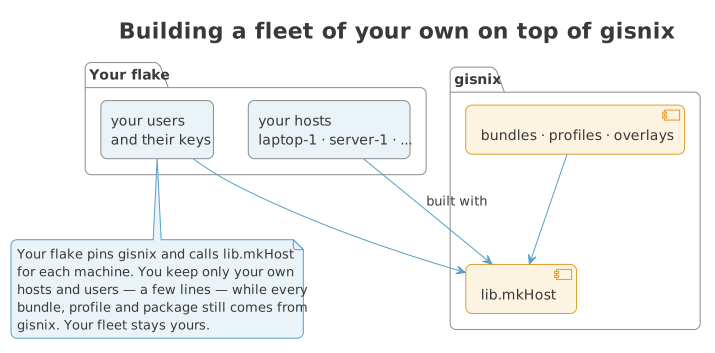
lib.mkHost and lib.mkFleet are exposed specifically so another flake can
build one host, or many, from GISNIX's bundles, profiles and overlays while
keeping only its own hosts/<name> and users/<name> — no vendored copy of
software/, profiles/, or overlays/. This is how the installer's own
generated per-machine flake works, and how a bigger fleet flake works too.
For the day-to-day workflow (config picker, rebuilding, adding a second machine) see Building your fleet. This page is the underlying API.
A single host
{
  inputs.gisnix.url = "github:kartoza/gisnix";
  outputs = { self, gisnix, ... }: {
    nixosConfigurations.myhost = gisnix.lib.mkHost "myhost" {
      hostPath = ./hosts/myhost;
    };
  };
}
hostPath points at a directory in your own repo, shaped like
hosts/example/ (see Adding a host). gisnix.lib.mkHost
wires in disko/agenix/home-manager/stylix, resolves your config.nix's
bundle list against GISNIX's registry, and applies GISNIX's overlays — all
without your flake needing to know any of that exists.
A fleet
{
  inputs.gisnix.url = "github:kartoza/gisnix";
  outputs = { self, gisnix, ... }: {
    nixosConfigurations = gisnix.lib.mkFleet ./hosts { };
  };
}
mkFleet scans ./hosts for subdirectories carrying a config.nix (the
same convention hostconfig.py's own host discovery uses) and calls
mkHost once per name found — add a host by adding a directory, not by
also editing flake.nix.
The second argument takes:
perHostArgs— keyed by hostname, for the one host that needs something the others don't (stableCosmic,extraModules, its ownprojectConfigoverride):
gisnix.lib.mkFleet ./hosts {
  perHostArgs.myhost.extraModules = [ ./hosts/myhost/something-extra.nix ];
};
projectConfig/fleet— see the next section. Set once here to apply to every hostmkFleetbuilds, instead of repeating it per host.
A flake managing dozens of hosts doesn't have to use mkFleet at all —
calling mkHost in your own loop works exactly as well, and is worth doing
directly if your fleet has per-host machinery (a deploy-method registry,
hardware-specific extras) beyond what mkFleet's perHostArgs covers.
Your own projectConfig and fleet
mkHost/mkFleet default to GISNIX's own config.nix and hosts/fleet.nix
— example.com, nixosStateVersion = "26.05", no Hetzner/Keycloak/whatever
else your own fields are. Any host or module that reads a projectConfig
field GISNIX's own config.nix doesn't have will hard-fail on a missing
attribute; any field both sides define (like nixosStateVersion) will
silently take GISNIX's value instead of yours if you don't override it.
Supply your own:
gisnix.lib.mkHost "myhost" {
  hostPath = ./hosts/myhost;
  projectConfig = import ./config.nix;   # your own, real values
  fleet = import ./hosts/fleet.nix;      # your own, real machines
}
fleet matters even for a single host: GISNIX's services-system/
fleet-hosts.nix (part of the always-on services-system bundle) reads it
to generate /etc/hosts entries for every machine it names — pass your own
so ssh anotherhost resolves correctly, or omit it if you don't maintain a
fleet registry at all (an empty { hosts = {}; } is fine).
Re-attaching a genericized module's private content
A few of GISNIX's shared modules are deliberately generic where a real
value would have to be private — services-system/ca-certificates.nix
doesn't ship anyone's actual internal CA, it exposes an
extraCA.certificateFiles option (empty by default) instead. If your own
fleet needs one, extraModules re-attaches it exactly like any other
private addition:
gisnix.lib.mkHost "myhost" {
  hostPath = ./hosts/myhost;
  extraModules = [
    { extraCA.certificateFiles = [ ./resources/my-ca-chain.crt ]; }
  ];
}
gisnixRoot: reaching GISNIX's own profiles directly
hostPath's own files (default.nix, desktop.nix, services.nix, ...)
receive gisnixRoot as a specialArg — this flake's own root, as an
absolute path. Use it instead of a ../../ path (which would resolve
against your repo, not GISNIX's) to import one of GISNIX's non-bundle
profiles directly:
This is for the handful of profiles that aren't bundle-driven (they turn on
an activation option, or pull in hostPath's own desktop.nix/
services.nix — a bundle structurally can't do either). Bundle content
itself doesn't need this: gisnix.lib.mkHost already imports
profiles/bundles.nix from GISNIX's own tree regardless of where hostPath
points, so a bundles = [ "desktop-browsers" ] entry in your config.nix
resolves correctly with no path juggling on your side at all.
Your own inputs
hostPath's files also receive an inputs specialArg — but by default it's
GISNIX's own inputs, not yours. A host file referencing a flake input
your own flake declares (a vendored kernel, a private tool) fails with
"attribute missing" even though the input genuinely exists — it's just not
in the inputs this host file was handed.
gisnix.lib.mkHost "myhost" {
  hostPath = ./hosts/myhost;
  consumerInputs = inputs;   # your flake's own inputs, not gisnix's
}
mkFleet takes the same parameter, applied to every host it builds. This
only affects the inputs specialArg your own hostPath files see —
GISNIX's internal use of its own inputs (disko, home-manager, its own
overlays) is unaffected either way.
Known gotchas from a real migration
Two real failures, found migrating an existing, non-trivial fleet onto
mkHost — worth knowing before you hit them yourself.
nixpkgs.config set directly, from more than one module.
nixpkgs.config.allowUnfreePredicate and
nixpkgs.config.permittedInsecurePackages are bare, loosely-typed attrs
keys with no per-key merge behaviour — the module system silently keeps
only ONE definition if more than one module sets either directly. GISNIX
avoids this internally via kartoza.unfreePackages/kartoza.insecurePackages
(services-system/unfree.nix), which are real listOf str options that
concatenate. If your own extraModules (or a private module you layer in)
sets nixpkgs.config.allowUnfreePredicate or
nixpkgs.config.permittedInsecurePackages directly instead of using those
two options, expect a package one of your OWN modules explicitly permits to
still refuse evaluation with "marked as insecure"/unfree — silently, no
error pointing at the real cause. Use kartoza.unfreePackages/
kartoza.insecurePackages from any module instead; they're additive
regardless of what else is declared.
boot.zfs.forceImportRoot conflicting with an existing host's own
setting. GISNIX's base bundle sets this true unconditionally — it
fixes a real installer bug (the live ISO and the freshly-installed system
have different ZFS hostids on first boot). A host you're migrating that
predates disko — an existing install, hostid already consistent — likely
already sets this false in its own hardware.nix. Two plain (non-
mkForce) definitions of the same value is a hard eval error
("conflicting definition values"), not a silent one. Fix it in your own
host file with lib.mkForce false, not by changing GISNIX's default (which
is correct for the fresh-install case every OTHER host relies on).
Extending GISNIX's tooling to your own bundles
There's no mechanism yet for a downstream flake to add modules to a
bundle name GISNIX already defines — if you take desktop-kartoza-apps (or
whatever bundle) and GISNIX's own copy is narrower than what you want,
add your own modules via extraModules rather than trying to extend the
bundle itself. Tracked as a real gap, not a design decision — a future
version may let a consumer register additional modules under an existing
bundle name.
What's proven
- Building a host with
hostPathoutside GISNIX's own tree — thehostPath/gisnixRoot/fleetspecialArgs exist specifically to make this correct (see Architecture). mkHost/mkFleetaccepting a realprojectConfig/fleetoverride instead of GISNIX's own placeholders.mkHost/mkFleetaccepting aconsumerInputsoverride, so a host file referencing an input only your own flake declares resolves correctly.- A real fleet migration (three hosts, one with pre-existing hardware predating disko) — see the gotchas above, both found and fixed this way.
nix run github:kartoza/gisnix#configure -- <host>and#bundles, run from inside a downstream flake's own directory with no GISNIX checkout present at all.configure.py/hostconfig.pysplit "where the bundle catalogue lives" (GISNIX's own tree, via aGISNIX_ROOTenvironment variable the nix-packaged command sets) from "where the target host's files live" (the caller's own working directory), so the chooser edits your flake'shosts/<name>/config.nixwhile reading the bundle registry from GISNIX itself.docs-generate-hosts(per-host reference pages) the same way — reads GISNIX's publisheddocs/references/software.jsonfor package metadata, but runsnix evaland writes generated pages against the calling flake's own root.gisnix update(ornixos-rebuild switch --flake .#myhostdirectly) and editingconfig.nix's bundle list by hand.
What isn't wired up yet
- Extending an existing bundle name from a downstream flake — see
above;
extraModulesis the workaround. gisnix create-host(adopting an already-installed machine) still assumesutils/and the targethosts/live in the same checkout — it wasn't part of this round of fixes, since the workflow it serves (bring a self-installed machine into a flake) doesn't apply to a flake generated by the installer, which already has ahosts/<name>/.docs-generate-software/-bundles/-commandsanddocs-build/-servebuild GISNIX's own public site and were never meant to run against a downstream flake's data — a consumer wanting its own docs site (real hostnames, private topology) should build a separate one, not try to feed private data through GISNIX's public generator.